Huracán will deliver a new, physical understanding of tropical cyclone risk across the British and Irish Isles, Western Europe, and the Northeast United States in a changing climate.
Huracán is a strategic UK–US collaboration with the overarching objective to deliver a new, physically based understanding of the risks posed by cyclones of tropical origin (CTOs) to the British and Irish Isles and Western Europe (BIWE) and the Northeast United States (NEUS) in a changing climate.
What are CTOs—and why do we care?
Some tropical cyclones migrating into the mid-latitudes retain the physical characteristics of a hurricane, while others evolve into post-tropical cyclones. Both types, which we collectively call CTOs, can be extremely intense and their hazards set them apart from typical extratropical cyclones. Do recent CTO landfalls signal an emerging climate risk for BIWE and NEUS? Further, can we imagine a sequence of events leading to a CTO directly hitting New York or London, and what would be the consequences?
Huracán in a nutshell
The risk of CTOs is currently poorly quantified, owing to a fundamental lack of evidence; yet these events are high-impact and are expected to become more frequent in the future. Poor theoretical understanding impedes confident prediction. Huracán brings together world-leading expertise—from both sides of the Atlantic—to study, for the first time, the full life cycle of CTOs, a key requirement for scientific progress. Huracán will address fundamental knowledge gaps exploiting diverse observations, theoretical advances and hypothesis-driven analysis of a wealth of numerical simulations, to provide actionable information to decision-makers. Huracán will explore physically plausible scenarios, given the predictable components of future climate and the conditional dependence of cyclone processes on those components. Huracán will experiment with the simulation of CTO-specific impacts and investigate worst-case configurations of the physical climate system. This concerted effort will transform the assessment of CTO risks across the North Atlantic mid-latitudes.
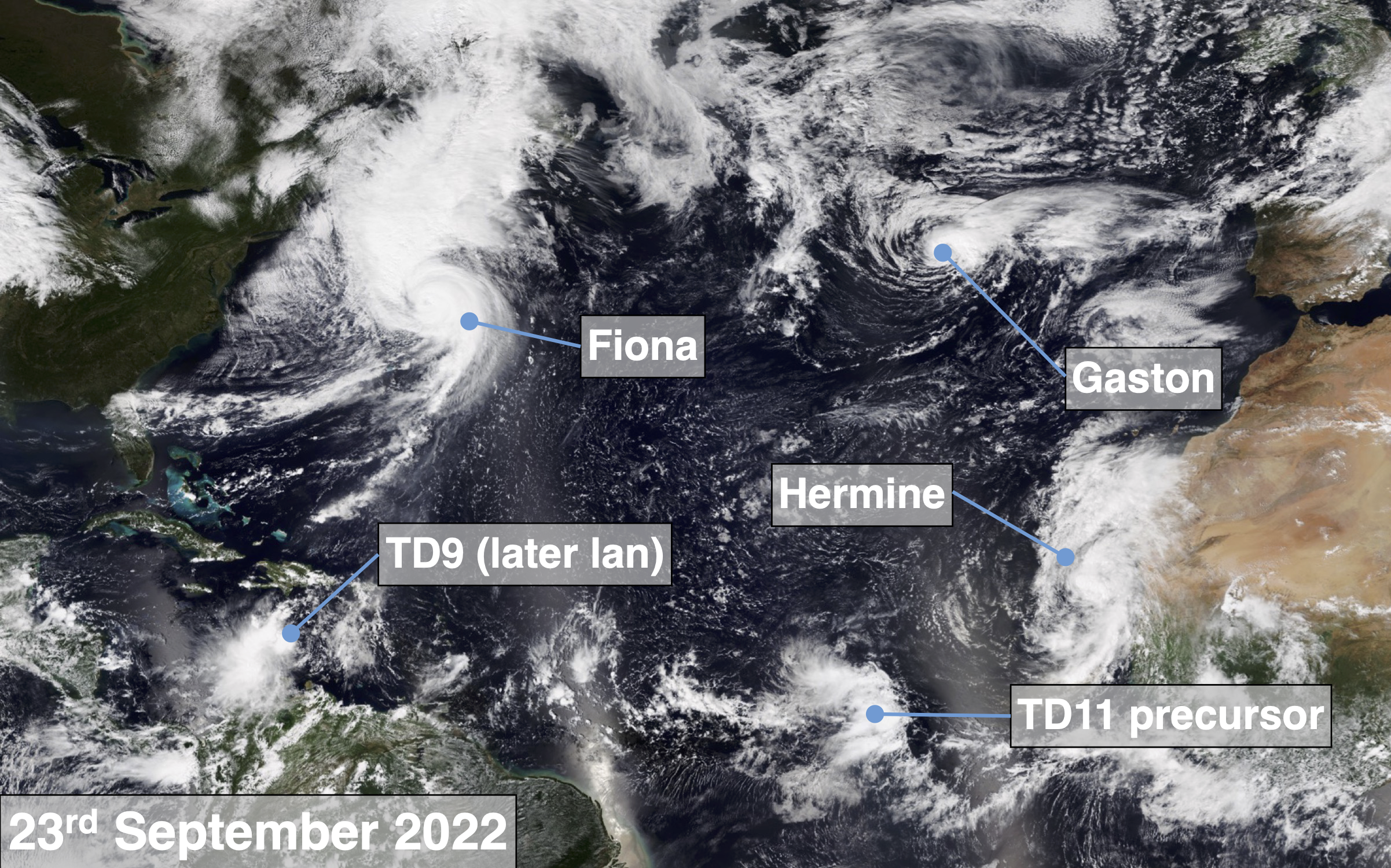
This satellite image, taken 23rd September 2022, shows multiple cyclones across the North Atlantic at various stages in their lifecycles. Two tropical depressions are seen: TD11 (in its precursor stage) off the west coast of Africa and TD9 further along in its development in the southern Caribbean. Two named tropical cyclones are present: Fiona, recurving along the US East Coast, and Hermine, seen migrating directly from the tropics towards southwestern Europe. Close to Western Europe, Gaston is transforming from a tropical storm into an extratropical storm, a process seen in approximately half of tropical systems. This image, a striking snapshot of North Atlantic weather, illustrates the broad range of cyclone processes, the varied physical storm risks, and the complex scientific problems that Huracán is tackling.
Our Objectives
Research in Huracán is centred around three core objectives:
Objective 1 | To identify and quantify the key processes governing the life cycle of CTOs that impact BIWE and NEUS
Objective 2 | To identify and understand the key driving mechanisms that govern the interannual to decadal variability of CTO hazards across BIWE and NEUS
Objective 3 | To understand how anthropogenic climate change is affecting and will affect CTO risk to BIWE and NEUS
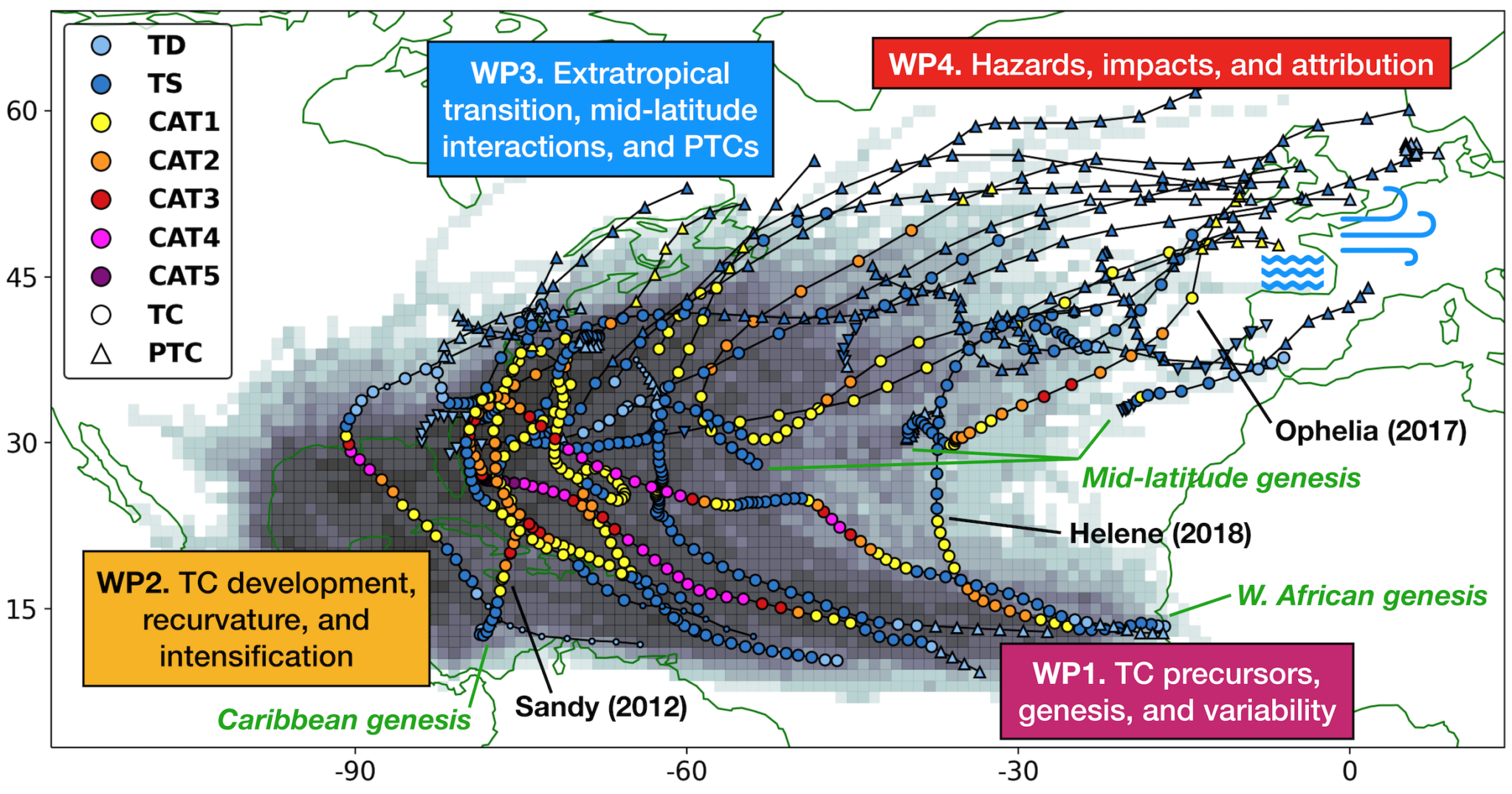
This diagram illustrates selected tropical cyclone tracks that have reached mid-latitude regions and how the structure of the Huracán project follows the complete lifecycles of these systems.
Work Packages
Huracán will study the origins, development, landfall and impacts of North Atlantic CTOs. Research will be divided into four work packages, which are structured to naturally follow the lifecycle of a cyclone originating in the tropics, moving into the mid-latitudes, and reaching land.
Work Package 1 | Determining the impact of African climate variability and change on TC precursors, genesis and frequencies
Work Package 2 | Characterising TC intensification and tracks that contribute to CTO evolution
Work Package 3 | Developing process understanding of the life cycles of CTOs entering mid-latitudes, and the dependence of their variability on large-scale phenomena
Work Package 4 | Attribution of variability and change in large-scale drivers of CTOs to anthropogenic climate change, and implications for hazards and impacts
Explore the project at research.reading.ac.uk/huracan